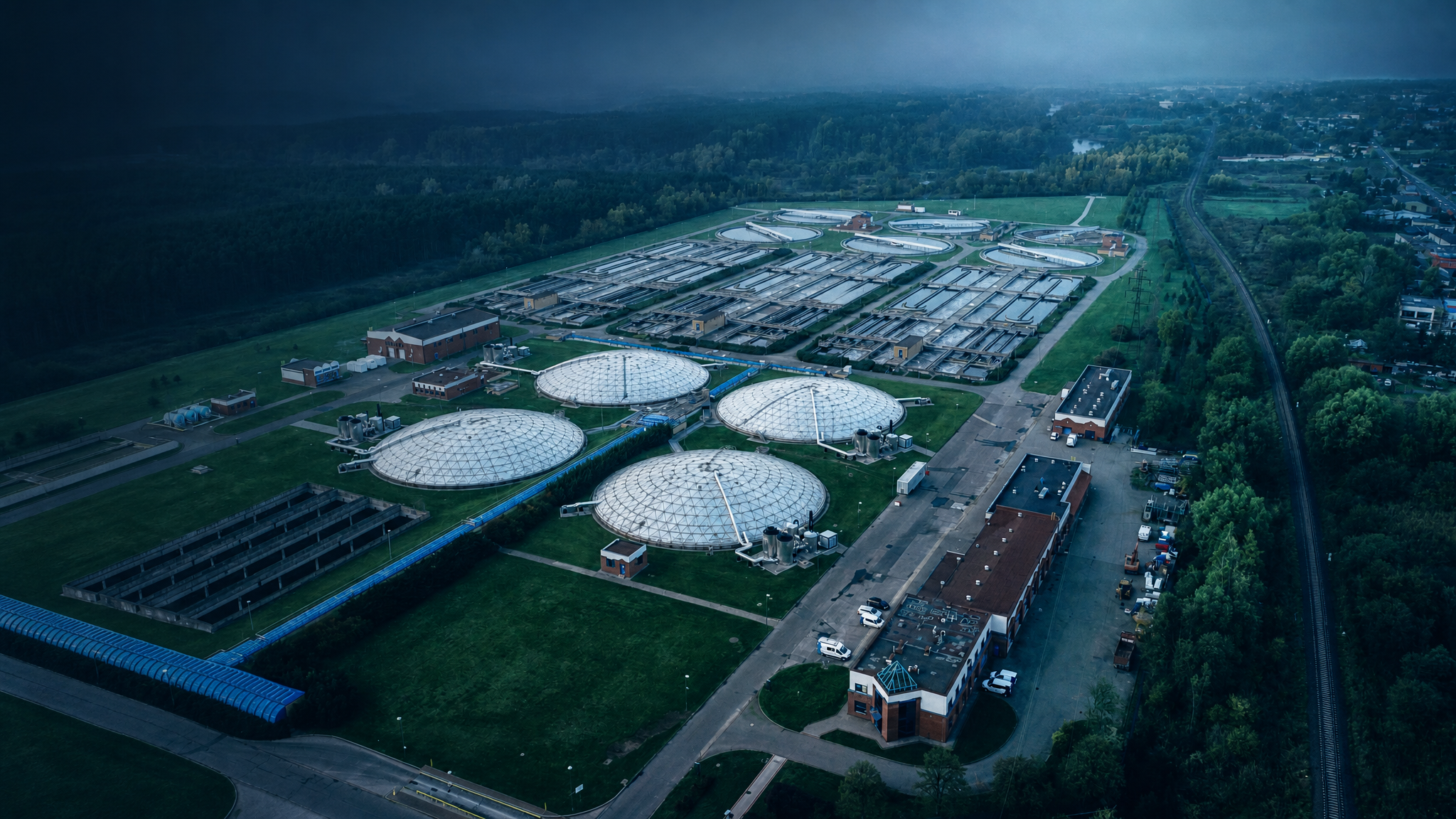
How Much Space Does Tertiary Treatment Require?
Footprint comparison of tertiary treatment technologies for plant upgrades.
Space requirements for tertiary treatment vary dramatically — from as little as 15 m² per 10,000 m³/d for a disc filter to over 150 m² for a conventional rapid gravity sand filter. For most retrofit projects, footprint is the binding constraint: the available space determines the technology shortlist, not the other way around. Compact technologies like disc filters and cloth media filters have transformed what is achievable on constrained sites. When even compact add-ons don't fit, containerised, above-ground, or stacked solutions can work.
Key Numbers
Footprint Comparison by Technology
Disc / Cloth Media Filter
CompactSmallest footprint of all filtration technologies. Can be installed outdoors or in existing buildings.
Continuous Sand Filter
MediumModerate footprint. Multiple cells arranged in parallel. Height ~4–5 m.
Rapid Gravity Sand Filter
LargeLargest footprint. Requires filter building, backwash system, and clear well.
Dissolved Air Flotation (DAF)
MediumCompact per treatment capacity but needs saturator, recirculation pumps.
Membrane Filtration (MF/UF)
CompactSmall physical footprint but requires CIP system, permeate tank, chemical storage.
MBBR Polishing Stage
MediumCan reuse existing tanks, reducing net new footprint to near zero.
Engineering Insight: Footprint Is Not the Whole Story
Space-Saving Strategies
Reuse Decommissioned Basins
Convert old sedimentation tanks, digesters, or sludge storage into tertiary treatment reactors. Reduces excavation and concrete work to near zero.
Build Above Existing Structures
Place filter equipment on platforms over covered tanks or channels. Common in urban plants with zero ground-level space.
Containerised / Modular Systems
Pre-engineered units delivered on a standard container footprint (< 15 m²). Can be stacked or placed on paved areas, rooftops, or temporary foundations.
Combine Chemical + Physical in One Step
Inline coagulation/flocculation ahead of a disc or cloth filter eliminates the need for a separate chemical reactor basin.
For Constrained Sites
Ready to upgrade your treatment plant?
Get a preliminary engineering assessment tailored to your plant’s specific conditions and requirements.
Frequently Asked Questions
Related Content
Last reviewed: August 2026. Regulatory requirements may vary by national implementation. This content is for informational purposes and does not constitute legal or engineering advice.